More than 500 local 100-Day Challenges have run across nine provinces since 2021. Each one matched a frontline team with one bold goal and gave them 100 days to reach a real, measurable result. This page shows you how to start one.
The method is the same for everyone. A team closest to the problem sets an uncomfortable goal, builds its own plan, and moves from policy on paper to results on the ground in 100 days. We train the Coaches and Strategists who guide the work. The teams they support deliver the results, and these results belong to them.
Any organisation can start, whether you are an NGO, a municipality, a government department, a university, a private corporation, or a funder. Choose the package that fits, and we will help you shape the challenge around a priority that matters to you.
What you get
You get a measurable result, delivered by your own people. A 100-Day Challenge brings design, coaching, capacity building, and communications into one package, pointed at a single outcome.
A result, not a plan. You end with a verified change on the ground, measured against a baseline, not a report or a course completion.
Your people own it. Two of your own become certified Challenge Coaches and Strategists by running a real challenge. The skill stays inside your organisation.
Evidence you can show. A professional Impact Story, a live dashboard, and a Day 100 public showcase turn the result into proof for funders, councils, and communities.
Choose your Package
One model, four ways in, priced for different types of organisations. The number that matters most is how many Challenges you set in motion, and over what time frame.
SPARK
1 Challenge
About 100 days, guided online
For NGOs, community organisations, and first-time teams who want to test the method before committing to a fully coached sprint.
Read more
Template-based, self-guided challenge design
Group coaching webinars
A basic team tracker and a starter communications template
One-off press release
Digital 100-Day Challenge kit
SPRINT - Recommended
3 Challenges over two supported cycles
About 10 to 11 months
The full Local Impact Sprint. One team runs the first cycle, and up to two teams the second. Best for municipalities, departments, and NGOs
Read more
An expert-led design session, with the problem framed for your context
Two officials certified as a Challenge Coach and a Strategist, by doing a real challenge
A dedicated 100-Day Challenge Coach-guide across both cycles, with virtual sessions and WhatsApp accountability
A professional Impact Story and a media campaign built on your verified results
A full team dashboard and coach feedback
A supported second cycle, led from the inside
The full physical 100 Day Challenge kit and NWU short course certificates
Eligible for the Annual National Impact Awards
SCALER
Up to 10 Challenges
Two supported cycles, up to 5 teams running at once
For provincial departments, large municipalities, and state-owned entities ready to run several challenge teams at the same time.
Read more
Everything in Sprint, delivered at scale
An executive strategy session plus expert design
Five or more certified internal facilitators (Challenge Coaches and Strategists)
Dedicated coaches-guide for concurrent teams
Executive and provincial dashboards
Communications support throughout: media campaign, newsletter, and a professionally edited video feature
Full kits for every team, and a featured category in the Annual National Impact Awards
SUSTAIN
Continuous Challenges
Ongoing for returning teams
For organisations whose coaches are already certified and have run a 100-Day Challenge before, and want to keep going.
Read more
Access to the latest self-guides and an updated media pack
Group webinars plus two sessions with a coach-guide
A Masterclass for past certified participants
Recognition of prior learning
Eligible for the Annual National Impact Awards
How each Challenge Works
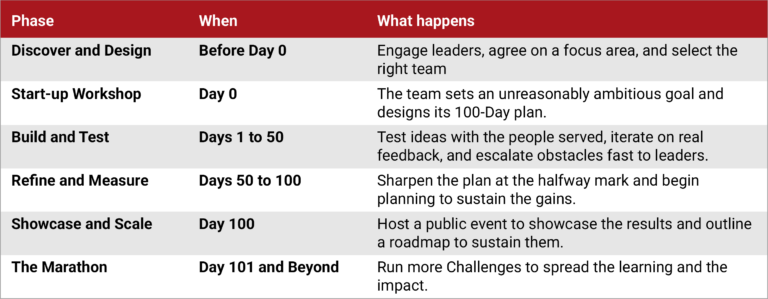
Every Challenge follows the same disciplined six-phase journey. One 100-day Challenge runs about 20 weeks, from first design to public showcase.
Who it is for
The same methodology works across sectors and organisation types:
NGOs and community organisations
Municipalities and national government departments
Provincial departments and state-owned entities
Universities, colleges, and TVET institutions
Corporates and funders, for CSI, ESG, and B-BBEE Socio-Economic Development
Funding
Reach out to see whether you can join an existing funded route with one of our convening partners. We can also provide a budget motivation tailored to your procurement category.
Every 100 Day Challenge begins with two trained people in place: a 100-Day Challenge Coach to guide the method, and a Challenge Strategist to clear the way. We train Coaches and Strategists. The teams they guide deliver the results, and those results belong to them.
This 20-week learning programme produces a group ready to guide local 100-Day Challenge delegates. Delegates learn the full arc of a Challenge: preparing the track, running the Start-Up Workshop, holding the weekly rhythm, refreshing at the halfway mark, driving the final surge, and passing the baton. The learning journey starts with a 3-day orientation session followed by 20 weeks of learn-and-do in parallel.
The 100-Day Challenge Coach
Coaches are doers who work well in the background: development facilitators, learning and development practitioners, programme coordinators, and skilled facilitators. The role rewards listening, attention to detail, and persistent positivity.
What they will learn and do
Design and facilitate the three workshops that propel the Challenge forward: Start-Up, Refresh and Scale-Up.
Hold a weekly accountability rhythm that keeps a team doing, not only planning.
Coach a Team Leader and run honest one-to-one check-ins.
Guide the team on the results data so that a layperson could tell, on Day 100, whether the team succeeded.
Spot and grow the next set of Coaches, so the method spreads.
The Challenge Strategist
Strategists are senior people with authority and access: directors, senior municipal officials, department heads, and funders’ programme leads. The role rewards convening power and a willingness to remove obstacles rather than issue instructions.
What they will learn and do
Shape a Challenge, select a local team and create the conditions that enable the Team to set and achieve an unreasonably ambitious goal., Engage leadership, secure commitment, and clear systemic roadblocks.
Support from the sideline rather than direct from the top.
Institutionalise the method beyond Day 100, so one sprint becomes a marathon.
Certification
Certification is issued as a Short Course by North-West University, through the School of Industrial Psychology and Human Resource Management.
On the Sprint package, two of your officials become certified as a 100-Day Challenge Coach and a Challenge Strategist by running a real 100-Day Challenge and submitting the evidence of their practical work through seven assignments. They are certified alongside the practical skills they gain from running a live challenge.
Alignment to QCTO qualifications is being finalised.
Getting Started
Starting is straightforward:
Pick a priority you want to make radical progress on.
Choose the package that fits, or ask us to help you decide.
Send an Expression of Interest
We shape the challenge with you and confirm a start date.
Your team runs its first 100-day sprint.
Orientation dates for 2027
Each journey starts with a three-day face-to-face orientation for the selected internal facilitators
Planned dates for 2027: 9-11 March, 6-8 April, 4-6 May, 1-3 June, and 6-8 July.
Ready to Start?
Tell us the problem you want a team to move on. We will help you shape a 100-Day Challenge proposal around it.
Jot down thoughts on these questions – to the extent they are relevant to your experience at the session:
When did the mood in the event shift from “why are we here?” to “this could be interesting – I am excited to be part of this.” What triggered this shift?
When did you have to go “off script” on the agenda or to change the agenda? What triggered this? What did you adjust? How did it go?
What was most surprising to you at the event?
What new insights did you gain about the issue at hand, and about the way leaders in the system interacted with each other?
Where did the conversation get stuck? What got it unstuck?
How would you characterise the level of trust among participants in the meeting? To what extent did this shift as the meeting progressed? To what do you attribute this shift, if indeed it happened?
Thought starter...
Reflection Questions
Jot down thoughts on these questions – to the extent they are relevant to your experience at the session:
When did the mood in the event shift from “why are we here?” to “this could be interesting – I am excited to be part of this.” What triggered this shift?
When did you have to go “off script” on the agenda or to change the agenda? What triggered this? What did you adjust? How did it go?
What was most surprising to you at the event?
What new insights did you gain about the issue at hand, and about the way leaders in the system interacted with each other?
Where did the conversation get stuck? What got it unstuck?
These are 100-Day Challenge Mentors.
They did some work before you received the Challenge Note. This included:
Writing the Challenge Note, and making sure that the leaders of all the organisations represented on the team are comfortable with it – and committed to supporting the work of the team
Helping the leaders of these organisation recruit you and your colleagues to the team
Gathering some baseline data and other information that will help you and your teammates set your 100-Day goal and develop your plan.
Making sure all the preparations are made for a successful Lift-Off workshop, when you and your teammates will meet and get your 100-Day Challenge started. This includes venue, facilitation support, food, swags, comms, travel arrangements and whatever else is needed.
Mentors will participate in all or part of the Lift-Off Workshop, mostly at the start to provide context and answer questions, and at the end to give you and your teammates feedback about the goal and plan you develop.
During the 100 days following the Lift-Off Workshop, here’s what the Mentors will do:
They will check in every two weeks with the team leaders to see how the team is doing and what support they and the team need.
They will keep other organisational leaders informed and engaged during the 100 days, and pull them in to help as needed.
They will participate in the last part of the Refuelling Workshop, halfway through the 100 days, to see what additional support the team needs, and to begin to plan with the team for sustainability and scale-up.
They will work with the team at the Sustainability Workshop to finalise recommendations on sustaining the results and building on the work of the team.