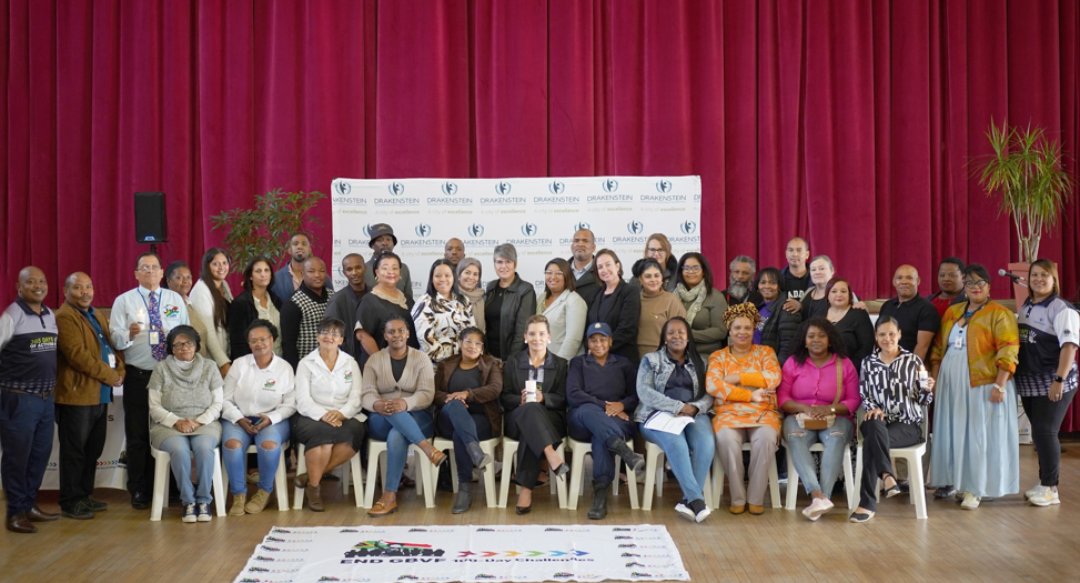
Drakenstein Municipality: a permanent GBVF hub, built in 100 days

A survivor in Drakenstein could know that help existed somewhere and still not know where the referral pathway started. The people most likely to notice early signs, ECD teachers who see children every day, had no training in what to do about it. Men were largely absent from the conversation. And a mother seeking counselling had nowhere to put her children while she did it.


The 100-Day goal

Reduce the incidence of GBVF in the community through education and support: equip 500 ECD teachers, engage 100 men as active allies, and train 500 women as community ambassadors.

The results

Every target was met.

Educators, men and women ambassadors together account for 1,100 people who now understand the local referral pathways for GBVF cases. The engagement from men was the surprise. The team expected to work for that number and instead found a level of commitment to being part of the solution that outstripped what they had planned for.

The most durable result is a permanent GBVF Hub for the municipality: a therapeutic, safe space for survivors and their families, with a child-friendly therapy room so that a parent can receive counselling while their children are safely occupied nearby. The Hub operates in partnership with the Department of Social Development, the Thuthuzela Care Centre and SAPS.

Who did the work

A municipal team working across sectors with DSD, the TCC, SAPS and community partners, including qualified social workers.

How they did it

Weekend programmes and community marches did the volume work. The partnership that moved the message furthest was an unlikely one: Virgin Active, whose fitness events and 5km “Wear Black” run carried the message to people who would never attend a GBVF workshop.

The harder story is what happened inside the team. Time management slipped and burnout arrived, which is ordinary in this work and usually ends a sprint quietly. The team responded with clearer task delegation and a standing team “gym session”, a protected slot for recuperation and self-care. They credit it directly for the fact that they finished.

What continues

The Hub is permanent and the referral partnerships behind it are formalised. The team is institutionalising debriefing sessions with qualified social workers, having concluded that processing the emotional toll is a condition of doing this work for longer than 100 days.

Share the Post:

Thought starter reflection questions

Jot down thoughts on these questions – to the extent they are relevant to your experience at the session:
  • When did the mood in the event shift from “why are we here?” to “this could be interesting – I am excited to be part of this.” What triggered this shift? 
  • When did you have to go “off script” on the agenda or to change the agenda? What triggered this? What did you adjust? How did it go?
  • What was most surprising to you at the event?
  • What new insights did you gain about the issue at hand, and about the way leaders in the system interacted with each other?
  • Where did the conversation get stuck? What got it unstuck?
  • How would you characterise the level of trust among participants in the meeting? To what extent did this shift as the meeting progressed? To what do you attribute this shift, if indeed it happened?

Thought starter...

Reflection Questions 

Jot down thoughts on these questions – to the extent they are relevant to your experience at the session:

  • When did the mood in the event shift from “why are we here?” to “this could be interesting – I am excited to be part of this.” What triggered this shift? 
  • When did you have to go “off script” on the agenda or to change the agenda? What triggered this? What did you adjust? How did it go?
  • What was most surprising to you at the event?
  • What new insights did you gain about the issue at hand, and about the way leaders in the system interacted with each other?
  • Where did the conversation get stuck? What got it unstuck?
These are 100-Day Challenge Mentors. 

They did some work before you received the Challenge Note. This included:

  • Writing the Challenge Note, and making sure that the leaders of all the organisations represented on the team are comfortable with it – and committed to supporting the work of the team
  • Helping the leaders of these organisation recruit you and your colleagues to the team
  • Gathering some baseline data and other information that will help you and your teammates set your 100-Day goal and develop your plan.
  • Making sure all the preparations are made for a successful Lift-Off workshop, when you and your teammates will meet and get your 100-Day Challenge started. This includes venue, facilitation support, food, swags, comms, travel arrangements and whatever else is needed.


Mentors will participate in all or part of the Lift-Off Workshop, mostly at the start to provide context and answer questions, and at the end to give you and your teammates feedback about the goal and plan you develop.

During the 100 days following the Lift-Off Workshop, here’s what the Mentors will do:  

  • They will check in every two weeks with the team leaders to see how the team is doing and what support they and the team need.
  • They will keep other organisational leaders informed and engaged during the 100 days, and pull them in to help as needed.
  • They will participate in the last part of the Refuelling Workshop, halfway through the 100 days, to see what additional support the team needs, and to begin to plan with the team for sustainability and scale-up.
  • They will work with the team at the Sustainability Workshop to finalise recommendations on sustaining the results and building on the work of the team.