
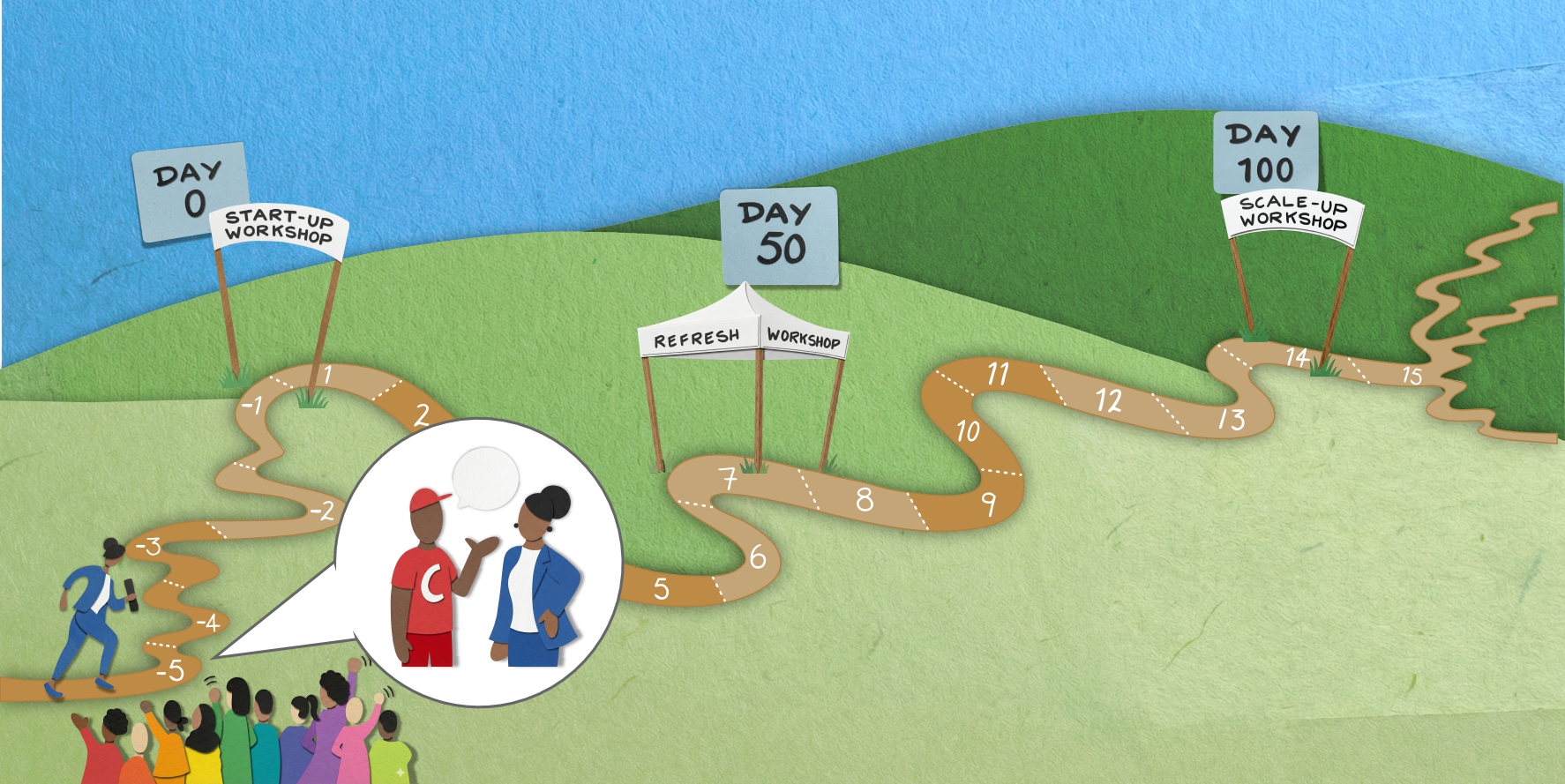



Week minus 5 – Anchoring with a Challenge Strategist
Week Minus 5
Anchoring with a Challenge Strategist
A 100-Day Challenge is a high-intensity, time-bound project. While it shares the basic components of any project — a team, a goal, and a plan — it functions differently from traditional government mandates.
Podcast
Every week, listen to the conversation between two 100-Day Challenges Coaches, discussing what needs to be done this week and with great tips! We are using AI to help us create these. This does mean you have to excuse their accents. (This is home-brew stuff, even if it does not sound like it).
Aligning the Local GBVF Ecosystem
The Power of “Team-First” Design – In most environments, leaders set a goal and assign it to a team. The 100-Day Challenge flips this logic: The team is selected first, and the team then develops the goals and plans. This bottom-up approach ensures that those closest to the work are the ones driving the solution.
However, before a team can be formed, leaders must first determine the general focus of the challenge. To get the leaders together, you need a “Challenge Strategist” who plays a vital role in aligning the local GBVF ecosystem. This is a functional role, not a formal job title, and it can be transitioned between leaders as the project evolves. They will:
Convening Stakeholders: Identifying and inviting key leaders from government agencies (SAPS, Health, Justice) and NGOs within the local GBVF ecosystem.
Facilitating Focus: Leading a collaborative meeting to gather diverse perspectives and decide on the specific area the 100-Day Challenge will target.
Enabling Action: Setting the stage so the 100-Day Team has the institutional support they need to succeed.
Why This Matters for GBVF Response: By involving a broad spectrum of stakeholders early on, the Challenge Strategist ensures the project isn’t operating in a silo. It creates the “political will” and multi-sectoral buy-in required to turn the National Strategic Plan into a local reality.
Your Tasks This Week
Select your Challenge Strategist
Your primary goal for the first week of the 100-Day Challenge is to identify, recruit, and brief the leader who will serve as your Challenge Strategist.
The Learning Deep Dive, “Finding a Challenge Strategist” , outlines three potential scenarios for filling this role:
A Coach as Strategist: One of the current Coaches steps into the role.
The Nominating Leader: The person who originally selected you for the Coach role assumes the position.
An External Leader: You identify and enrol a new leader from your network or department.
Click on this link to download a “leave behind” document you can share with prospective Challenge Strategists, so they are clear on what they are signing up for.
To succeed in enrolling the Challenge Strategist, you must fully understand the scope of this role and be ready to answer questions from prospective candidates. Use the following Learning Deep Dives to prepare for these high-level conversations:
The 100-Day Challenge Overview: A primer on the methodology
The National Strategic Plan (NSP) on GBVF: Contextualising your work with South Africa’s national mandate.
The Challenge Gallery: A showcase of past 100-Day Challenges that successfully translated the NSP into local, collective action to support survivors and reduce GBVF.
These resources are designed to equip both you and your Challenge Strategist to engage other high-level stakeholders. Together, you will begin the essential work of co-designing your 100-Day Challenge to create a tangible impact in your community.
Remember: you are encouraged to move faster than the program’s suggested pace. Every day saved in preparation is an extra day your team can spend impacting the lives of survivors.
Your Role as 100-Day Challenge Coach
There is one additional topic that is important to learn about during this first week of your 100-Day Challenge journey: your Role as 100-Day Challenge Coach. This Learning Deep Dive will help you understand the unique aspects of this role and the skills you will sharpen during your own 100-Day Challenge journey.
Jot down thoughts on these questions – to the extent they are relevant to your experience at the session:
When did the mood in the event shift from “why are we here?” to “this could be interesting – I am excited to be part of this.” What triggered this shift?
When did you have to go “off script” on the agenda or to change the agenda? What triggered this? What did you adjust? How did it go?
What was most surprising to you at the event?
What new insights did you gain about the issue at hand, and about the way leaders in the system interacted with each other?
Where did the conversation get stuck? What got it unstuck?
How would you characterise the level of trust among participants in the meeting? To what extent did this shift as the meeting progressed? To what do you attribute this shift, if indeed it happened?
Thought starter...
Reflection Questions
Jot down thoughts on these questions – to the extent they are relevant to your experience at the session:
When did the mood in the event shift from “why are we here?” to “this could be interesting – I am excited to be part of this.” What triggered this shift?
When did you have to go “off script” on the agenda or to change the agenda? What triggered this? What did you adjust? How did it go?
What was most surprising to you at the event?
What new insights did you gain about the issue at hand, and about the way leaders in the system interacted with each other?
Where did the conversation get stuck? What got it unstuck?
These are 100-Day Challenge Mentors.
They did some work before you received the Challenge Note. This included:
Writing the Challenge Note, and making sure that the leaders of all the organisations represented on the team are comfortable with it – and committed to supporting the work of the team
Helping the leaders of these organisation recruit you and your colleagues to the team
Gathering some baseline data and other information that will help you and your teammates set your 100-Day goal and develop your plan.
Making sure all the preparations are made for a successful Lift-Off workshop, when you and your teammates will meet and get your 100-Day Challenge started. This includes venue, facilitation support, food, swags, comms, travel arrangements and whatever else is needed.
Mentors will participate in all or part of the Lift-Off Workshop, mostly at the start to provide context and answer questions, and at the end to give you and your teammates feedback about the goal and plan you develop.
During the 100 days following the Lift-Off Workshop, here’s what the Mentors will do:
They will check in every two weeks with the team leaders to see how the team is doing and what support they and the team need.
They will keep other organisational leaders informed and engaged during the 100 days, and pull them in to help as needed.
They will participate in the last part of the Refuelling Workshop, halfway through the 100 days, to see what additional support the team needs, and to begin to plan with the team for sustainability and scale-up.
They will work with the team at the Sustainability Workshop to finalise recommendations on sustaining the results and building on the work of the team.
Login
Accessing this learning programme requires a login. Please enter your credentials below!