Facilitating the Refresh Workshop
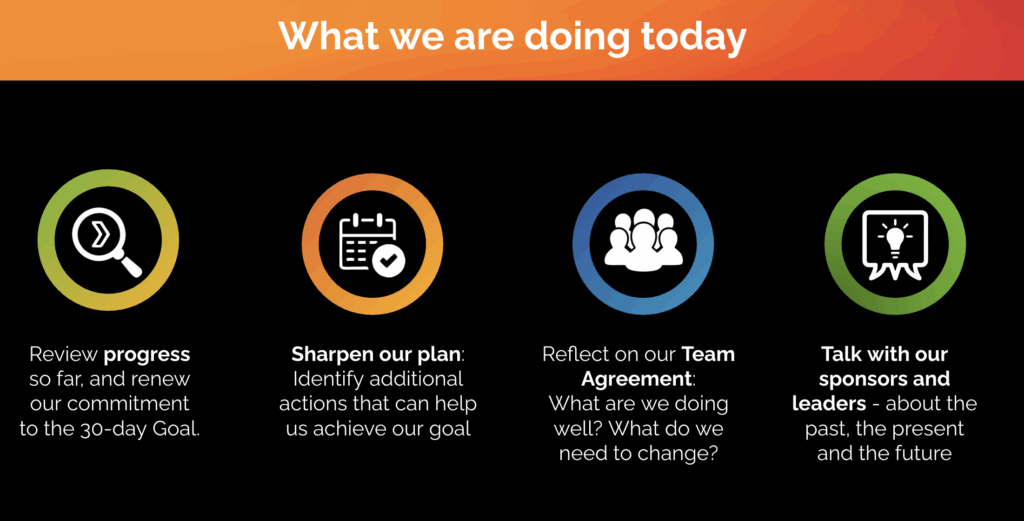
The Refresh workshop is a structured opportunity to pause, reflect, pivot (if needed), and get re-energised. It is a chance to recommit to the 30-day goal. And if good progress is being made, it is a time to kick off the thinking and the planning for sustaining the impact beyond the 30 days.
What success looks like at the end of the Workshop
Team members are energised for the second part of the 30-Day Project, with fresh ideas, increased confidence, and new insights on working together gained over the last two weeks. They are also beginning to think about ways to sustain the gains that will have been made by the end of the 30 days.
Watch the video to see the essence of the Workshop. (Your workshop has the same objectives as the 100-Day Challenge workshop in the video.)
Key outputs
- Revised Work Plan.
- Revised Team Operating Agreement.
- A short note to Sponsors outlining initial thoughts on sustaining the gains the team will make.
This facilitation guidance covers each section of the Refresh Workshop. Click on the “+” sign to see the step-by-step guide.
Download the slide pack template and have it in front of you when you go through this lesson (as we refer to the different slides)
Renew commitment to our goal (60 min)
Why do this? Welcome back team members, get them ‘off their feet’, and reflect early on in the workshop. This will build up team confidence in achieving the goal and generate initial ideas on increasing the odds of success.
1. Welcome everyone back and share the objectives and agenda of the workshop. For the warm-up exercise, use the 1-2-4 All exercise (See video below), to discuss the following questions:
- What was a pleasant surprise about working on this team?
- What was a not-so-positive experience working with this team?
- What made you a little uncomfortable
2. Progress: To get into a positive spirit, ask each team member to share 2-3 things the team did that helped make progress towards the goal. These could be post-it notes or just sharing.
3. Confidence vote:
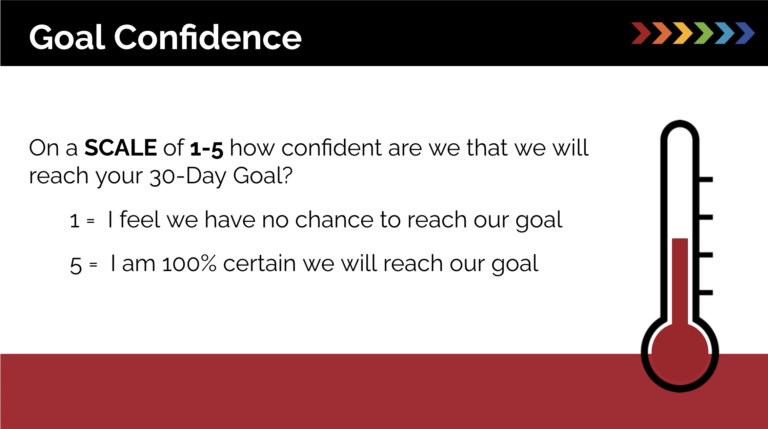
- Ask each team member to do a vote of confidence on the goal (It is best to ask them to pick a number and reveal this at once on post-its or use a Mentimeter survey)
- 1 = “no way in hell, no chance to reach our goal”
- 5 = “100% sure we will achieve this.”
- Discuss differences: Use the votes to ask probing questions and facilitate a conversation among team members:
- What makes you feel so confident?
- Why are you so pessimistic?
- What would it take to push your confidence up by 1 or 2 points?
- What will need to happen in the next two weeks to move your vote above 4? (Have someone capture these ideas on the flip chart. They will come in handy to strengthen the plan.)
4. Changes to the goal: Depending on the votes and the discussion, ask whether we can proceed with the goal, whether we should nudge it up ”to keep things exciting and challenging,” or whether we need to shift it down. Then let the team know that we will revisit these ideas when we sharpen our workplan.
Sharpen the plan (60 min)
Why do this? Based on the experience of the first two weeks, what can we do to increase the odds of success? Come up with new ideas and translate the promising ones into work streams or action steps in the plan.
1.Difficulties: Ask each team member to consider one issue related to the project that they are having difficulties with and would like help and advice on. These issues may have come up in the previous session.
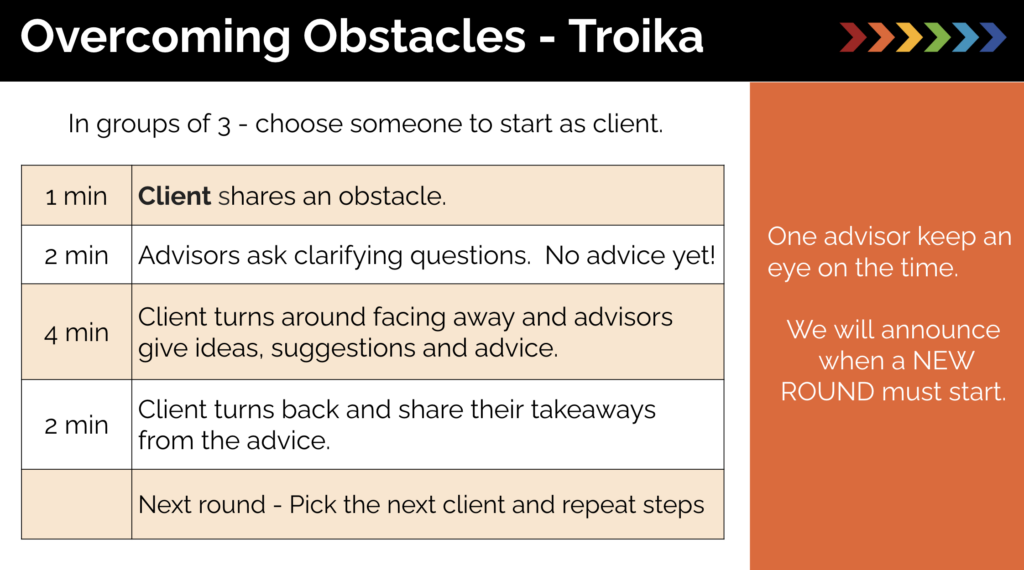
2. Advice: Use TROIKA Consulting (see the video below) to solicit fast and fresh advice from each other on these issues. If the team is only 4 people, three people can participate and one can give the instructions and keep time.
3. Adjust the plan: Ask the team to adjust the work plans based on the advice they received. And also, ask them to consider the question: “what else can we do to increase the odds of success, what new ideas can we pursue” (outside the current plan). Make sure to remind the team to go review the ideas that emerged in the previous session, and to turn these into concrete actions that can be added to the work plan.
4. Review the emerging work plan and make sure timing is aligned across work streams. Once that is completed…
- Ask the team again to vote on their confidence about achieving the goal.
- Ask them to decide on specific requests for support they may have of the mentor.
Reflect on our team agreement (30 min)
Why do this? Adjust the team agreement based on the experience of the first 2 weeks, and recommit to each other about honouring the agreement.
1. Living into our agreement? Load the team agreement on a mentimeter or hand out a copy of the agreement to each team member. Ask the team to vote on a scale from 1-7 on “how well we are living into each element of the agreement.” Use 1 for “not at all”, and 7 for “we are completely living into this”.
For a refresher on how to use Mentimeter, review the Week 1 topic “How to use Mentimeter as an engagement tool” Click here to watch the video.
2. Zero in on 2-3 elements of the agreement that got a low score (relative to others). Ask team members to consider the question: “what things can we do in the next two weeks to score better on this?”
If there are many ideas, ask team members to vote on the three that will have the highest impact. You can also do this in real-time using Mentimeter. Ask volunteers to own the top-voted ideas if there is implementation involved.
3. Ask everyone to think about recommendations to adjust and strengthen the agreement. Go around and solicit recommendations. Do thumbs up majority voting (if need be) to decide whether to adopt or reject each recommended adjustment/addition.
After you have adjusted the agreement on paper or the flip chart, ask everyone to sign it.
Talk with leaders and close-out (60 min)

Why do this? Get commitment from the Sponsor on support needed, and plant the seeds for amplifying and sustaining the 30-Day Project results. The close-out part is to ensure that the team leaves the event on a positive note and develops the habit of appreciating each other.
1. Asks from Sponsor: Ask the team to prepare bullet points on specific support from the Sponsor that the team will need in the next two weeks.
2. Sustainability: Ask the team to imagine that on day 30, they have been wildly successful in achieving their goal, but that in the next Organisational GBVF Health Check, the results returned to where they were before the 30 days. Brainstorm, using post-it notes, why performance dropped, group similar post-its into “sustainability risk” buckets, and name each.
3. Actions against risks: Ask for volunteers to focus on each sustainability risk bucket. Send them into breakout groups to discuss and come back with actionable steps or actionable recommendations for the Sponsor, as these relate to two questions:
- What can the team or others do in the next weeks to minimise this risk?
- What changes need to be implemented to avoid this sustainability failure, such as policy changes? Process changes? Role changes? Etc.
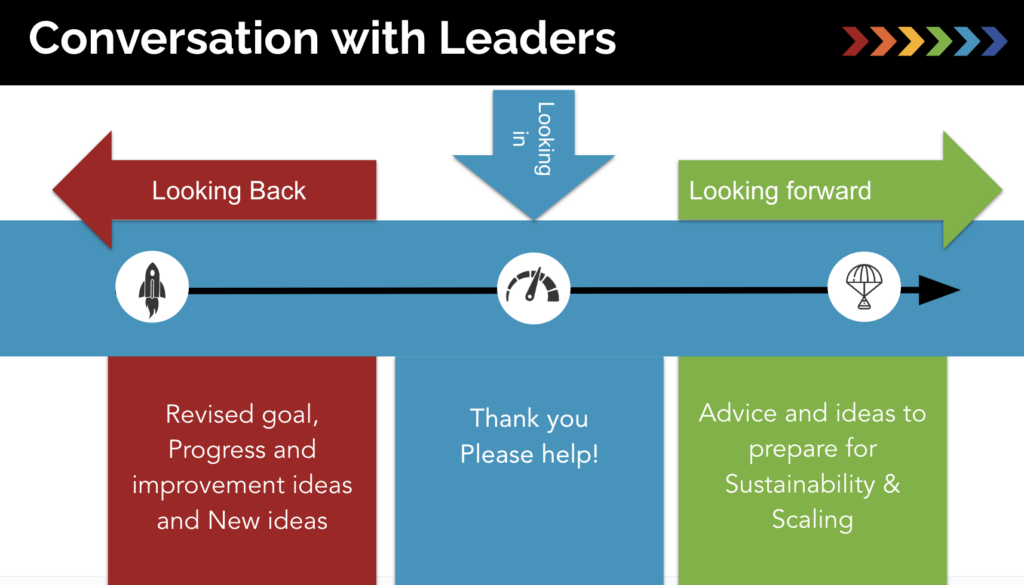
4. Debrief and prepare a short presentation to the Sponsor and leaders, including the support needed and ideas from the “sharpening the plan” discussion. This can be done in the form of:
- Looking back: Share the revised goal and highlights from the revised plan.
- Looking at the present: Thank the leaders and Sponsor for the support they provided so far, and ask for the support the team needs now.
- Looking forward: Share recommendations on risk mitigation and changes related to sustaining the gains.
5. Close-out:
- Workshop feedback: Ask the team to complete the short workshop feedback survey to help you keep improving.
- Appreciations: Introduce the activity by emphasising the importance of appreciating each other in this work. Here’s one fun way to express appreciation. We refer to it as the Paper Plate Awards:
- Pass out 2-3 paper plates to each person, and ask them to write their name and give them back to you
- Then, hand out three plates to each person (not giving them back their own).
- Ask team members to write an “award” to the individuals whose names are on the plates they received. The award will be “in recognition of” something they have done over the past two weeks that went above and beyond the call of duty.
- Go around the group and have people present the awards to each other.
- Closing comments – go around the room and ask each team member to respond to a question with one word. Questions you could use: “Share one word that best describes how you feel about your experience so far” OR “how you feel about the next two weeks?” Ask the Sponsor or leaders to give the last final word.
- Photo – Take a group photo and photos of the flip charts in case these get lost.