

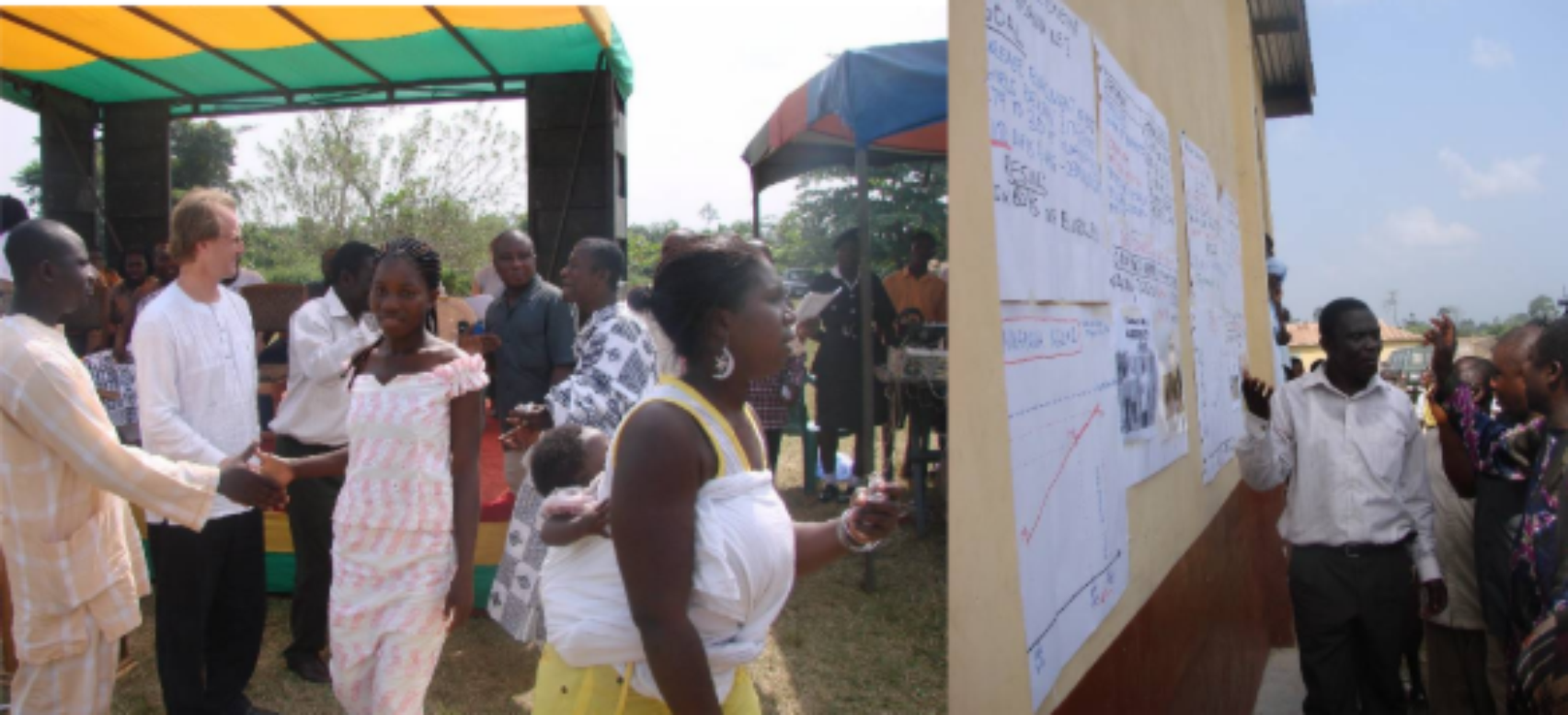

Community-Based Rural Development, Ghana: a classroom block at half the cost, and absenteeism cut from 49% to 16%

Rural development in Ghana ran through large contractors and district assemblies, and it was slow and expensive. In one district, a three-unit classroom block stood unfinished four years after construction began. A few feet away, in 2006, a Rapid Results team would build an identical block in 95 days. The prevailing belief, the hardest thing the initiative had to overcome, was that communities did not have the capacity to do this themselves. As Assin South's District Chief Executive admitted, when he first heard 100 days it sounded funny and he thought it could not work.

The 100-Day goal

Ten pilot teams across eight Area Councils in two Eastern and two Central region districts each took a construction-linked results goal. Crucially, the goal was never the building itself. As the CBRDP National Director put it, the goal is not a school building but what the building should do: reduce absenteeism, or lift enrolment.

Results achieved

One team reduced pupil absenteeism from 49% to 16% over the 100 days, alongside building a three-classroom block with office and store.

The cost result was the one that travelled. That three-unit block with office and store cost 173 million cedis, roughly 18,740 US dollars. The same block through conventional channels cost around 300 million cedis, roughly 32,500 US dollars. The World Bank Ghana country office verified the cost figures in December 2006. Across the ten teams, classroom blocks, a nurses’ quarters and other infrastructure were completed inside their 100 days.

Who was on the team

Cross-functional community teams that included traditional authorities. In one community the chief himself was mixing mortar. The initiative was run by the Community Based Rural Development Project under director Brown Matthew Oppong, with the Rapid Results Institute and Robert H. Schaffer & Associates, and local coaches drawn from existing CBRDP staff.

What was done, and how the results were achieved

The cost savings came from several moves the teams made themselves. Funds were devolved to Area Councils rather than routed through a large contractor. Teams negotiated lower rates with local artisans by appealing to their shared stake in the community, and using local artisans rather than an outside contractor was also credited for the build quality, because, as one member said, the artisans’ own children would attend the school and so they insisted on the highest standard.

Transparency was engineered deliberately. One team leader held a weekly Gon Gon meeting with the whole community every Saturday to share the week’s finances. That openness broke the usual assumption that project leaders were pocketing money, and once the community trusted the process it contributed materials it had never contributed before. Many teams posted a community member to check in daily with the construction workers. One summed it up: tight supervision, no cheating.

The teams also improvised around the blockages. When funds were late, one worked with traditional authorities to loan money in the interim and with an NGO to mobilise books, and set an attendance rule so volunteers arrived on time. When rain stopped the materials truck, the Ongwa teams carried 200 bags of cement half a kilometre to the site, because, they said, they had to keep the 100 days.

What is being sustained, and how

CBRDP leadership stated plainly that they were after sustainability and scalability, not donor showcases. The clearest mechanism was the coaches: the Rapid Results Institute trained CBRDP staff in every region as Rapid Results coaches, and these were redeployed supervision staff rather than an added cost. The Deputy Minister of Decentralisation attended both regional wrap-ups and pledged to push all other regions and districts to adopt the approach. The report is honest that this was a beginning, and that only time would tell whether the aspiration held.

Share the Post:

Thought starter reflection questions

Jot down thoughts on these questions – to the extent they are relevant to your experience at the session:
  • When did the mood in the event shift from “why are we here?” to “this could be interesting – I am excited to be part of this.” What triggered this shift? 
  • When did you have to go “off script” on the agenda or to change the agenda? What triggered this? What did you adjust? How did it go?
  • What was most surprising to you at the event?
  • What new insights did you gain about the issue at hand, and about the way leaders in the system interacted with each other?
  • Where did the conversation get stuck? What got it unstuck?
  • How would you characterise the level of trust among participants in the meeting? To what extent did this shift as the meeting progressed? To what do you attribute this shift, if indeed it happened?

Thought starter...

Reflection Questions 

Jot down thoughts on these questions – to the extent they are relevant to your experience at the session:

  • When did the mood in the event shift from “why are we here?” to “this could be interesting – I am excited to be part of this.” What triggered this shift? 
  • When did you have to go “off script” on the agenda or to change the agenda? What triggered this? What did you adjust? How did it go?
  • What was most surprising to you at the event?
  • What new insights did you gain about the issue at hand, and about the way leaders in the system interacted with each other?
  • Where did the conversation get stuck? What got it unstuck?
These are 100-Day Challenge Mentors. 

They did some work before you received the Challenge Note. This included:

  • Writing the Challenge Note, and making sure that the leaders of all the organisations represented on the team are comfortable with it – and committed to supporting the work of the team
  • Helping the leaders of these organisation recruit you and your colleagues to the team
  • Gathering some baseline data and other information that will help you and your teammates set your 100-Day goal and develop your plan.
  • Making sure all the preparations are made for a successful Lift-Off workshop, when you and your teammates will meet and get your 100-Day Challenge started. This includes venue, facilitation support, food, swags, comms, travel arrangements and whatever else is needed.


Mentors will participate in all or part of the Lift-Off Workshop, mostly at the start to provide context and answer questions, and at the end to give you and your teammates feedback about the goal and plan you develop.

During the 100 days following the Lift-Off Workshop, here’s what the Mentors will do:  

  • They will check in every two weeks with the team leaders to see how the team is doing and what support they and the team need.
  • They will keep other organisational leaders informed and engaged during the 100 days, and pull them in to help as needed.
  • They will participate in the last part of the Refuelling Workshop, halfway through the 100 days, to see what additional support the team needs, and to begin to plan with the team for sustainability and scale-up.
  • They will work with the team at the Sustainability Workshop to finalise recommendations on sustaining the results and building on the work of the team.