




Developing our 100-Day Work Plan

Moving from Vision to Action - Developing our 100-Day Workplan

If the Goal is the team’s mission, the 100-Day Plan is its strategy. Without a disciplined plan, even the most ambitious goal remains “wishful thinking.”

Process time: 90 min

Deep Dive Video

Developing our 100-Day Work Plan

Strategy of "Best Guess"

In a 100-Day Challenge, we don’t wait for a perfect plan.

  • The Initial Roadmap: The plan represents the team’s “best guess” on Day 1 of what it will take to reach the goal.

  • Evolution in Action: As the team begins its work and learns what works (and what doesn’t), the plan will evolve, expand, and pivot.

Instructional Note: This session is a 90-minute deep dive. While designed for the Team Coach, these materials are the standard operating procedure for anyone facilitating this segment of the agenda.

Key Plan Components

A successful 100-Day Plan focuses on rapid cycles rather than long-term milestones.

Feature Description
Immediate Action Tasks that can start in the next 24–48 hours. One 15-day target the team sets for itself: to get something completed that is “celebration worthy”
Owner-Led Every action has one name next to it—no “shared” responsibilities.
Adaptive A commitment to update the plan during every weekly meeting.

Facilitator's Focus: Overcoming "Analysis Paralysis"

Government environments often reward cautious, slow planning. Your role in this 90-minute session is to:

  1. Push for Specificity: Move the team from “we should improve communication” to “Officer X will call the Health Department Lead by Tuesday.”

  2. Encourage Risk: Remind them that the plan should change as they learn from the frontline.

  3. Drive Discipline: Ensure the plan is documented and visible to everyone from the start.

We suggest that you use 5 steps to help the Team develop its 100-Day Plan.

Generate ideas

Cluster the iease into themes

Create a plan for each theme, on a 100-Day Timeline

Make sure these thematic plans synch up with each other, and add up to the 100-Day Goal

Stress-test the 100-Day Plan

Step 1 - Generating Ideas (15 min)

Start by brainstorming on a flip chart using post-it notes. 

  • Hand each team member a packet of post-it notes and a pen. Ask them to think about actions, ideas, or strategies that can help them make progress towards the 100-Day Goal. Ask them to write one action/idea/strategy on a post-it note. 
  • After a brief period of idea generation, ask the group to look at the wall of Post-it notes to see if this inspires additional ideas. You can do another round of individual “ideation” with post-it notes. If the ideas are all related to doing things a little better, challenge them to come up with completely new ideas. 
The examples of post-it’s in the slides refer to a planning for dinner party for 20 friends in such a way that 80% of them will rate it as the “most amazing party” they have ever been to! And the party will be held in 100 days.

Step 2 - Cluster Ideas into Themes (10 min)

Ask the group to start clustering the post-its that go together and to label each cluster with a heading (theme) that best describes the cluster. These themes help the Team divide and conquer. The Team can split into groups of 2 or 3, with each group focusing on one theme.

Step 3 - Creating Thematic Plans (20 min)

Before the session, you had created a blank timeline with several “swim lanes” on flip charts (see the swim lanes slide below). Each swim lane will be used to turn a cluster of post-its into a thematic plan.

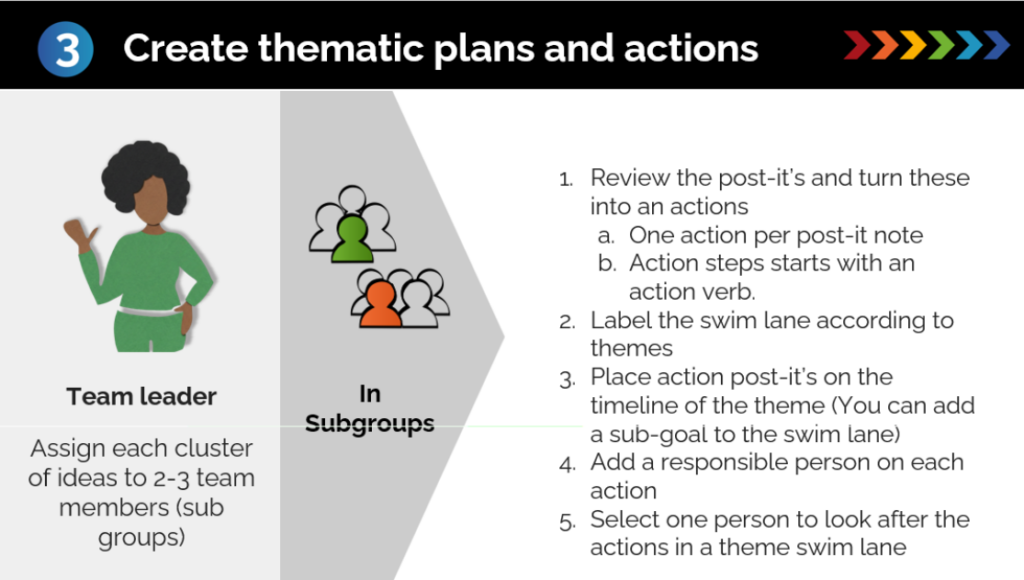
Solicit the help of the Team Leader to assign each cluster to 2-3 team members (sub-group). Then ask each sub-group to review the post-it’s and turn these into an organised plan, in one swim lane. The plan will be comprised of a number of action steps that are written out on post-it notes and placed in the appropriate sequence and timing in their respective swim lane. 

It is important to pay special attention to the first two weeks: the “immediate actions” that will create momentum.

Each sub-group will label its swim lane with the theme of the cluster: Food, Music, Activities, Etc. The swim lane will capture all the action steps related to its particular theme. For example, the action steps in the Music theme could include:

  • Ask invitees about their favourite music sets and the music they cannot stand.
  • Create a playlist based on the above research
  • Buy booster speakers to ensure sound quality
  • Set up the speaker system
  • Designate someone as the DJ so they adjust the music depending on the mood. 
Note that each of these action steps starts with an action verb. 

In some cases, the sub-groups can add a sub-goal to its swim lane. This typically relates to the 100-Day Goal but is focused on a particular theme. For example, when it comes to the music theme, the sub-goal could be: “At the end of the party, 75% of the guests will agree that their favourite piece of music was played, 100% of them will agree that there was no “annoying” music played, and 80% will agree that the music played fit the mood perfectly.”

Finally, the sub-group suggests a Team member who will be responsible for making sure that each action step happens. The name of the Team member is added to the post-it note. 

Step 4 - Synch up the Thematic Plans (20 min)

 The whole Team looks over all the swim lanes to see if the timing between them synchs up. For example, the party activities may need to be decided on before the decision on the food is finalised to ensure that the food lends itself to the types of party activities that are planned. So the step of deciding on party activities may need to be moved up in time to allow the food planning and preparation to proceed on time. 

The Team also reviews the totality of the 100-Day Plan to determine if implementing all these actions will achieve the overall 100-Day Goal. If not, what is missing? What new themes need to be added? For example, if there are extreme introverts among the guests, we may need to create a “quiet space” that allows them to recover from all the interactions with others. Otherwise, their assessment of the party will likely be negative. If this is the case, the team might add a “please the introverts” theme, add a swim lane, and build a plan for the swim lane. 

One final note: It is useful for the Team to decide on a few 15-Day Milestones. Tasks that they plan to complete in the first two weeks that will give them confidence that they are on the path to achieving their 100- Day Goal.  

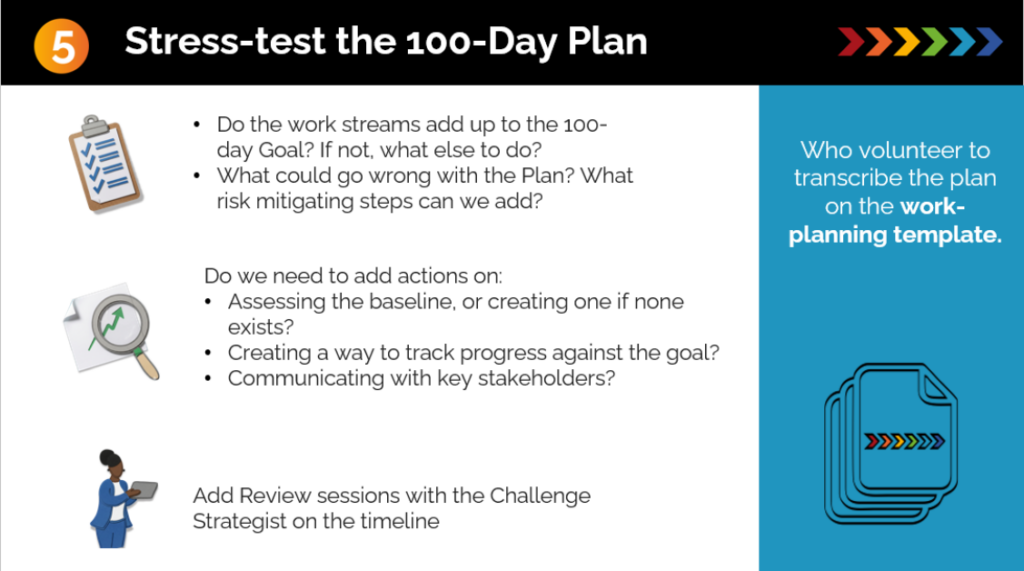
Step 5 - Stress-Testing the Plan (15 min)

The Team reviews the overall plan and adjusts action steps as needed. It is okay to have the swim lanes crowded in the first month and less crowded in months two and three. 

Review sessions with the Challenge Strategist can be added to the Plan. 

Ask the Team if they need to add actions related to the following:

  • Communicating with key stakeholders?
  • Assessing the baseline or creating one if none exists?
  • Creating a way to track progress against the goal?

The Team Leader can volunteer or assign someone to transcribe the timeline into a work-planning template. Click on the button to download it. 

Action Planning Template Explained

Creating Planning Swim Lanes

Quiz Yourself