


The Scale-up Workshop marks the end of the team’s journey in the 30-Day Challenge. This will happen in Week 5. The team will need to do some work in Week 4 to prepare itself for this. This Deep Dive provides an overview of the Scale-up Workshop and helps you work with the team to prepare for it.
What success looks like at the end of the Scale-up Workshop
The team will feel proud of what they have achieved and will feel acknowledged and honoured for the hard and creative work they did and for the impact they helped create. They will feel that, even though the past 30 days were exhausting, it was an experience they would love to go through again.
The senior leaders will feel proud of the team and will look back at the experience as liberating: “We do not have to figure out everything ourselves. We have a bigger role to play… We need to decide on a direction of travel and then pick the right team to explore the way forward. We trust that they will figure things out. We will stand back and support them as they do this.”
Watch the video to see the essence of the Workshop.
(The Video show 100-Day Challenge but the essence of the workshop is the same for the 30-Day Project)
Key outputs
Decision on steps the team will take, if any, to complete the 30-Day project, and support. needed to complete these steps
Decisions on steps Leaders will sponsor, if needed, to ensure that the team’s gains can be sustained and even amplified.
Decision on where to focus the next 30-Day Project(s) to continue on the organisational GBVF maturity journey.
Helping the team prepare for the Scale-up Workshop
Schedule a 90-minute meeting with the team to help them prepare for the Scale-up Workshop. Several leaders will be in attendance at the Workshop, and the team will use the Workshop to help them make decisions and commitments that will help amplify the work of the team.
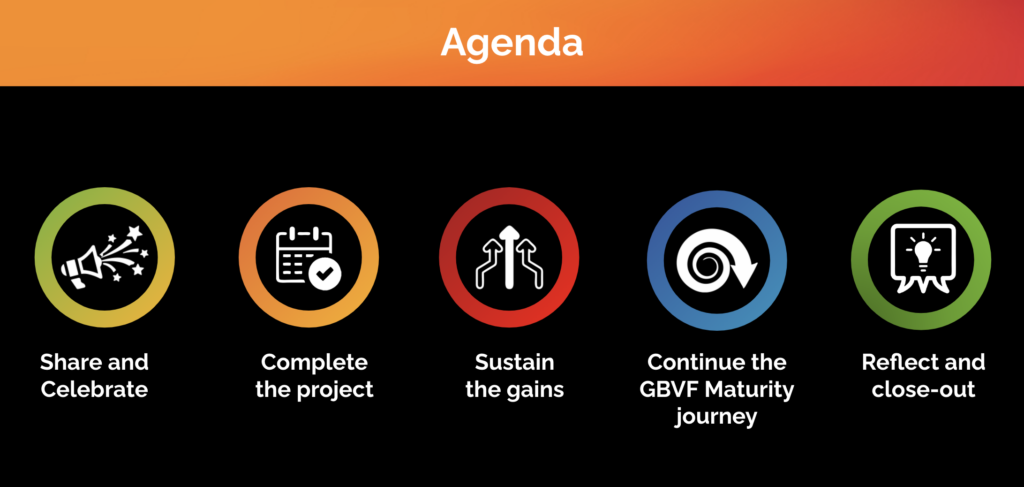
Below is guidance on the preparatory work the team will need to do next week for each of the agenda items of the Scale-up Workshop.
Share and Celebrate
Work with the team to prepare a “Show & Tell” presentation. The team can present in whatever format they choose. The team should start with their 100-Day Goal, and the progress they made towards it. Then they can find creative ways to share “their story”:
Other achievements they are proud of
Problems they encountered, and how these were solved (or not)
Other innovations the team tried, and what they learned from these
How the 100-Day journey affected them personally.
Past teams used videos, quiz shows, poems, bedtime stories, and plays to tell their story. Show some of these to the team, and encourage them to go wild.
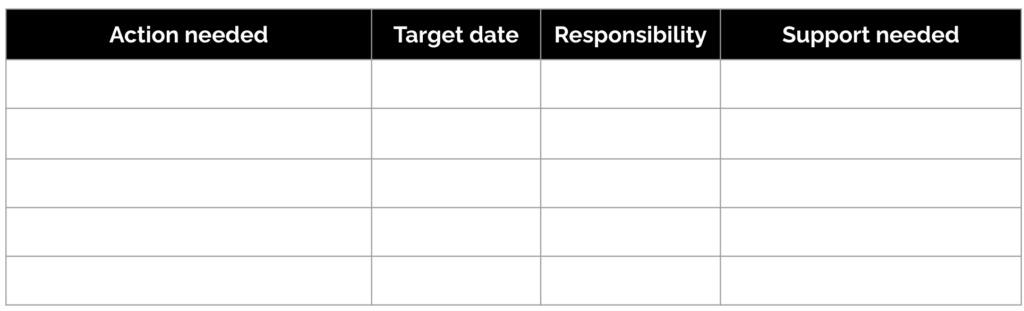
If the team feels that it will need an additional week or two to complete its project, please work with the team to develop an extension plan to complete the project. You can use the format below to prepare the plan.
If the team completed the project by the end of the 30 days, then this agenda item can be removed from the Landing Workshop.
Sustain the Gains
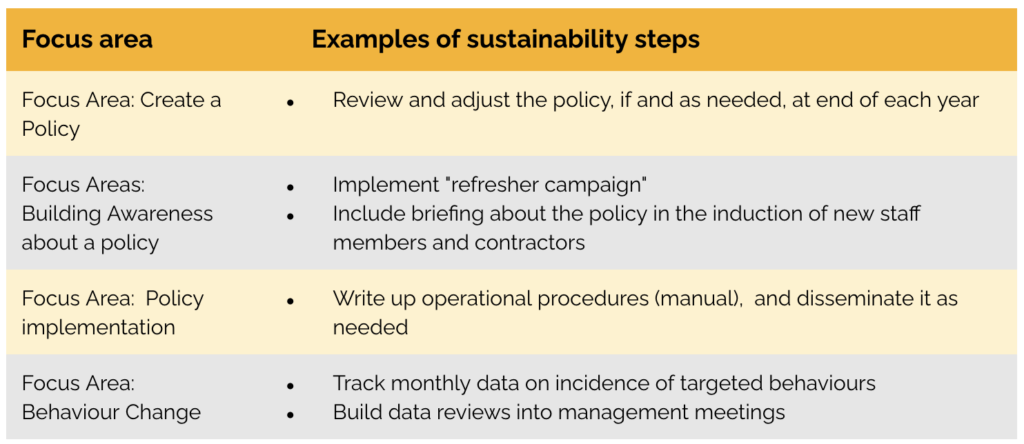
Brainstorm with the team about steps leaders can adopt to sustain the gains. These will be presented by the team to the Leaders at the Scale-up Workshop. Here are some thoughts on some of the steps that could help sustain the gains made in each type of focus area of GBVF Maturity 30-Day Project.
Continue the GBVF Maturity Journey
The purpose of this discussion with the team is to provide some advice to leaders on the focus for the next GBVF Maturity 30-Day Project (s).
For policy-related projects, 30-Day projects can be done sequentially:
A ‘Create a policy’ Challenge can be followed by
the “build awareness about the policy’ challenge, and then by
‘Implement the policy’ challenge.
For behaviour change-related projects, here are some options to consider for follow-up 30-Day Projects.
Raise the bar on the goal (for example, if the goal was to reduce incidents by 30%, the next goal may be to eliminate the incidents.
Spread the behaviour goal to other parts of the organisation.
Choose another behaviour based on the results of the Health Check survey.
The team prepares to present these recommendations and the thinking behind them to the leaders at the Scale-up Workshop.
Reflect and Close-out
No advance preparation with the team is needed for this agenda item.
Jot down thoughts on these questions – to the extent they are relevant to your experience at the session:
When did the mood in the event shift from “why are we here?” to “this could be interesting – I am excited to be part of this.” What triggered this shift?
When did you have to go “off script” on the agenda or to change the agenda? What triggered this? What did you adjust? How did it go?
What was most surprising to you at the event?
What new insights did you gain about the issue at hand, and about the way leaders in the system interacted with each other?
Where did the conversation get stuck? What got it unstuck?
How would you characterise the level of trust among participants in the meeting? To what extent did this shift as the meeting progressed? To what do you attribute this shift, if indeed it happened?
Thought starter...
Reflection Questions
Jot down thoughts on these questions – to the extent they are relevant to your experience at the session:
When did the mood in the event shift from “why are we here?” to “this could be interesting – I am excited to be part of this.” What triggered this shift?
When did you have to go “off script” on the agenda or to change the agenda? What triggered this? What did you adjust? How did it go?
What was most surprising to you at the event?
What new insights did you gain about the issue at hand, and about the way leaders in the system interacted with each other?
Where did the conversation get stuck? What got it unstuck?
These are 100-Day Challenge Mentors.
They did some work before you received the Challenge Note. This included:
Writing the Challenge Note, and making sure that the leaders of all the organisations represented on the team are comfortable with it – and committed to supporting the work of the team
Helping the leaders of these organisation recruit you and your colleagues to the team
Gathering some baseline data and other information that will help you and your teammates set your 100-Day goal and develop your plan.
Making sure all the preparations are made for a successful Lift-Off workshop, when you and your teammates will meet and get your 100-Day Challenge started. This includes venue, facilitation support, food, swags, comms, travel arrangements and whatever else is needed.
Mentors will participate in all or part of the Lift-Off Workshop, mostly at the start to provide context and answer questions, and at the end to give you and your teammates feedback about the goal and plan you develop.
During the 100 days following the Lift-Off Workshop, here’s what the Mentors will do:
They will check in every two weeks with the team leaders to see how the team is doing and what support they and the team need.
They will keep other organisational leaders informed and engaged during the 100 days, and pull them in to help as needed.
They will participate in the last part of the Refuelling Workshop, halfway through the 100 days, to see what additional support the team needs, and to begin to plan with the team for sustainability and scale-up.
They will work with the team at the Sustainability Workshop to finalise recommendations on sustaining the results and building on the work of the team.
Login
Accessing this learning programme requires a login. Please enter your credentials below!