




Setting our 100-Day Goal

Crafting our SMURF 100-Day Goal

This session is the heartbeat of the 100-Day Challenge. It is where a group of individuals transforms into a unified team with a single, binding commitment.

Deep Dive Video

Learning Objectives

By the end of this module, you will be equipped to facilitate a 100-Day Team as they convert a broad “impact indicator” into a specific SMURF Goal

Note: While you may be familiar with SMART goals, 100-Day Challenges use the SMURF framework to drive radical urgency and local ownership.

 Process time: 90 min

What to Expect: The Team Dynamic

Setting a goal is rarely “peaceful”—and that is by design. As a facilitator, you will observe the team’s natural internal dynamics surface:

  • The Risk-Averse: Those hesitant to commit to bold targets.

  • The Ambitious: Those pushing for high-impact results.

  • The Reckless: Those who may overlook practical constraints.

These interactions are vital. They help the team “stress-test” their collaboration and often reveal who the natural Team Leader will be for the 100-Day Sprint.

The Power of Autonomous Choice

In the GBVF response, “top-down” mandates are common. This session breaks that mold.

  • No outside authority tells the Team what their goal should be.

  • The Team negotiates the target among themselves.

  • Collective decision-making creates the “enabling environment” necessary to tackle complex social issues.

This isn’t just a planning exercise; it is a joint commitment that binds the team to a common purpose.

The 3 Step - Facilitation Process

To help you guide this conversation, we break the process down into three manageable steps:

StepFocusOutcome
1. Understanding SMURFThe difference between activity and results-oriented goals.Team members can tell what is a SMURF goal, and what is not.
2. ChoosingDeciding on what the 100-Day Goal will look like, and agreeing on the target. Draft 100-Day Goal
3. RefiningSharpening the Goal so success at the end of 100 days is crystal clear to Team members and outsiders.A signed-off 100-Day Goal.

Step 1: Understanding SMURF

Build out the logic of SMURF goals (Smart, Measurable, Unreasonable, Results-oriented, Fast), by engaging team members in two exercises:

a) Tennis Ball exercise. This helps the Team experience and appreciate the power of a group of people committing to unreasonable yet believable goals. It drives home the ‘U’ in SMURF.

Download the facilitation guide on the Tennis Ball Exercise to help you and you will also learn about this in the Face-to-Face training.

b)  Jeha & the King’s Donkey story. This drives home the ‘R’ in SMURF. This is essential to avoid the Team regressing from a results-oriented impact indicator goal (e.g. “increase the number of survivors who report gender-based violence” to an activity-oriented goal (e.g. conduct an awareness campaign on GBVF on campus). 

If you feel there is still ambiguity about what the R means in SMURF, use the A/B exercise to challenge the team to compare different types of goals. 

Emphasise the differences between SMART (Specific, Measurable, Achievable, Relevant, Time-bound) and SMURF goals.  Not all SMART goals are Results-Oriented. SMURF goals always are.  SMART goals are Achievable. SMURF goals are unreasonable and bordering on the impossible!

Step 2: Shaping the Team's 100-Day Goal

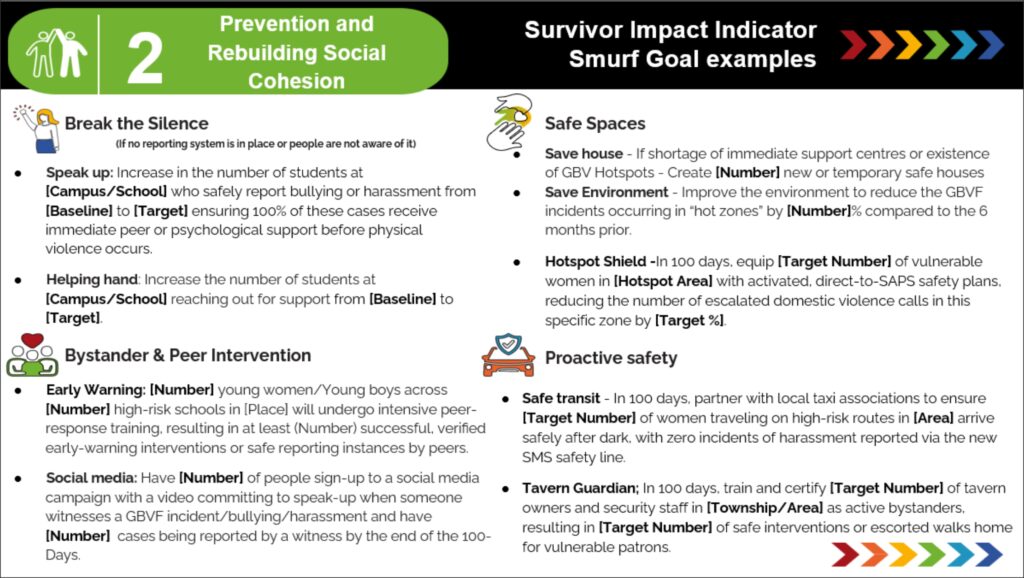
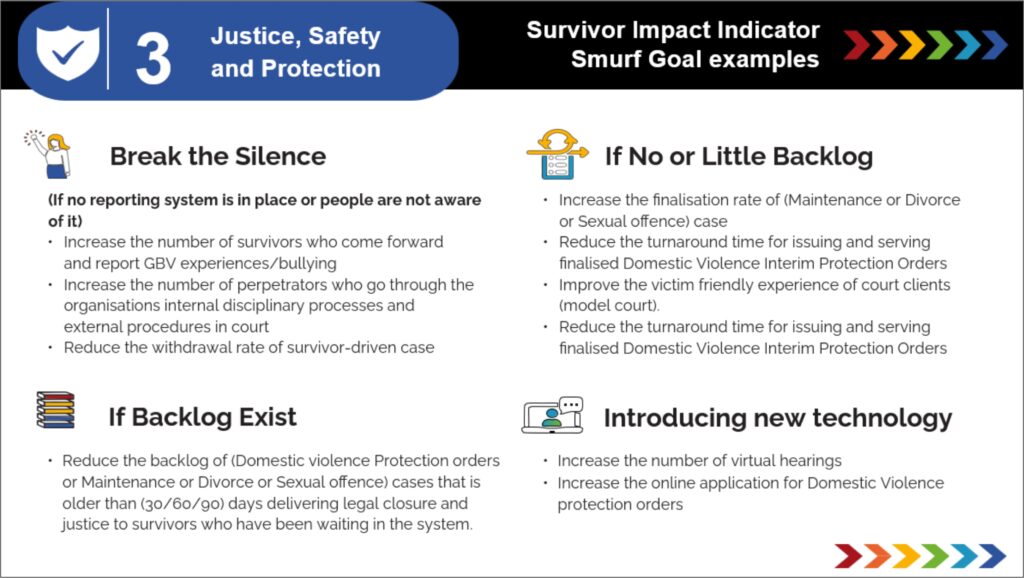
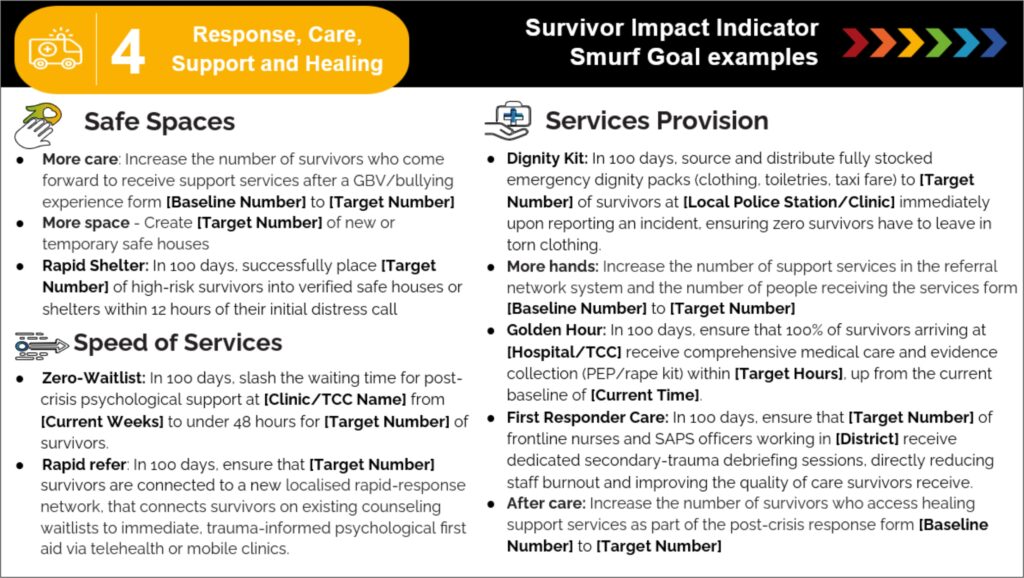
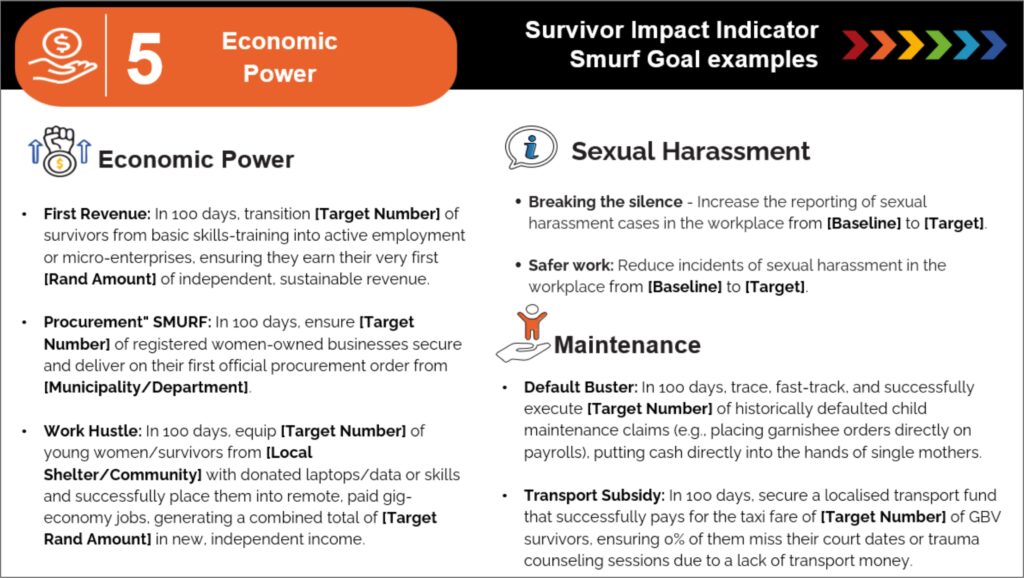
As part of your preparation for the Start-Up Workshop, you prepared two or three SMURF Goal templates that match the Focus Area (impact indicator) in the Challenge Note. 

Here are the 100-Day goal templates for different focus areas.  You can download a copy of it here to help you prepare your two to three templates:

Present the 100-Day Goal templates, you prepared, to the team. Ask them to discuss these to see which one they are comfortable with. If need be, customise one of these with them. Making sure they agree on how progress towards the goal will be measured. (20 min)

For the selected template, ask the team to fill in the blanks with numbers or percentages that represent how ambitious they would like to be in the next 100 days. 

  • After some initial discussion, you can ask each team member to write down a number or a percentage on a post-it note.  Then, they can share these and discuss. Use voting if need be. Remember that we are not seeking consensus but rather the willingness of each team member to work towards achieving this Goal. Naturally, if they feel that it is “pie in the sky”, they will not take it seriously. They need to believe that it is possible to achieve, however remote that possibility may be. 
  • Leave room for discussion and argument. It is essential that everyone feels heard before agreeing on a 100-Day Goal. Keep reminding the team that the leaders encouraged them to set highly ambitious goals. Remind them about the goals they heard about in the videos.
Here’s how some of the goals might look at the end of this step. 

Step 3: Refining the Goal

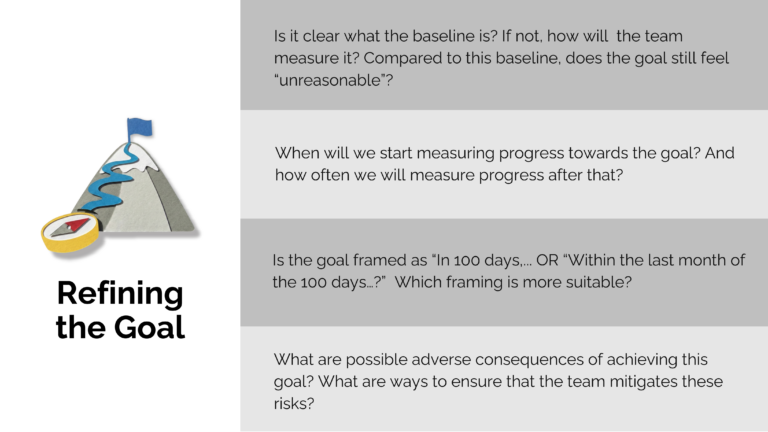
More often than not, the team will be so eager to move on to the 100-Day Plan that they fail to ask important questions about their 100-Day Goal (15 min):

  • Compared to the baseline, does the goal feel really “unreasonable”?
  • When will we start measuring progress towards the goal? And how often will we measure progress after that?  
  • Is the goal framed as “In 100 days,…” OR “Within the last month of the 100 days…?”  Which framing is most suitable?
  • What are the possible adverse consequences of pursuing this goal? What are ways to mitigates these? 

This step will help you guide the team as they discuss these questions so they can refine and, if need be, adjust their 100-Day Goal. After the preliminary goal is set, we suggest that you congratulate the team on completing the toughest part of the Start-Up workshop, and that you give them a short break.

Quiz Yourself