
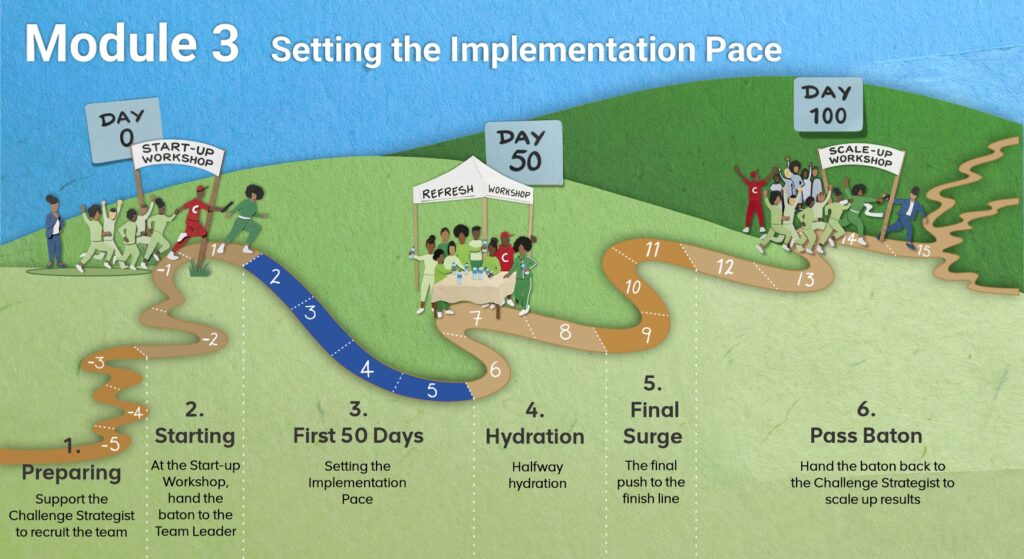




The Start-Up Workshop is over. Now, the real work begins. Your mission during these four weeks is to move the team from planning to a relentless weekly rhythm.
Podcast
Click to join (listen) two 100-Day Challenge coaches for a breakdown of this module, packed with practical tips for your team.
The Big Picture
With the 100-day clock ticking, maintaining momentum is crucial. Teams often face early hurdles such as fragmented data, systemic barriers, and the temptation to drift back into “business as usual.” This phase is all about establishing a disciplined weekly routine, finding evidence-based ways to track progress, and keeping the team laser-focused on their SMURF goal. As a coach, you will shift from directing to guiding, helping the team build their own accountability and leveraging their Challenge Strategist when they get stuck.
Your Roadmap
Week 2: The First Team Meeting
The “honeymoon phase” ends here. This week is about setting the standard for accountability.
Facilitator Move: Ensuring every Team member reports on what they did, not just what they thought about.
GBVF Context: Making sure the inter-departmental links (e.g., Police to Social Work) are actually communicating.
Week 3: Sorting out Data Issues
In GBVF work, data is often fragmented or delayed. This week, you help the Team stop waiting for “perfect” reports.
Facilitator Move: Helping the Team create “proxy indicators” or manual tracking systems that they own and control.
Week 4: Briefing the Challenge Strategist
You are the bridge between the frontline Team and the senior leaders (Sponsors).
Facilitator Move: Clearly articulating the “Systemic Barriers”—the rules or policies that the Team cannot change on their own—so the Strategist can intervene.
Week 5: Keeping the Team Focused
By Day 30, teams often start chasing “side projects.”
Facilitator Move: Using the 100-Day Plan as a filter. If an action doesn’t move the needle on the SMURF Goal, it gets parked.
Your Action Checklist
To stay on schedule, please ensure the following steps are completed by the end of this module:
Establishing Discipline: Facilitate the first “real-world” team meeting and ensure the management rhythm is respected.
Evidence-Based Action: Move the Team past the “we don’t have data” excuse to find creative ways to track progress.
Connecting Upward: Brief the Challenge Strategist to ensure the team’s early hurdles are being cleared at a leadership level.
Combating Drift: Ensure the Team isn’t getting distracted by “busy work” and is staying laser-focused on the SMURF Goal.
What's Next?
The Facilitator’s Mantra for this Phase: “Don’t do the work for them; make the work visible so they can do it.
After Week 5 come back to the page to complete your module assignment – have a peak at the questions now…
Jot down thoughts on these questions – to the extent they are relevant to your experience at the session:
When did the mood in the event shift from “why are we here?” to “this could be interesting – I am excited to be part of this.” What triggered this shift?
When did you have to go “off script” on the agenda or to change the agenda? What triggered this? What did you adjust? How did it go?
What was most surprising to you at the event?
What new insights did you gain about the issue at hand, and about the way leaders in the system interacted with each other?
Where did the conversation get stuck? What got it unstuck?
How would you characterise the level of trust among participants in the meeting? To what extent did this shift as the meeting progressed? To what do you attribute this shift, if indeed it happened?
Thought starter...
Reflection Questions
Jot down thoughts on these questions – to the extent they are relevant to your experience at the session:
When did the mood in the event shift from “why are we here?” to “this could be interesting – I am excited to be part of this.” What triggered this shift?
When did you have to go “off script” on the agenda or to change the agenda? What triggered this? What did you adjust? How did it go?
What was most surprising to you at the event?
What new insights did you gain about the issue at hand, and about the way leaders in the system interacted with each other?
Where did the conversation get stuck? What got it unstuck?
These are 100-Day Challenge Mentors.
They did some work before you received the Challenge Note. This included:
Writing the Challenge Note, and making sure that the leaders of all the organisations represented on the team are comfortable with it – and committed to supporting the work of the team
Helping the leaders of these organisation recruit you and your colleagues to the team
Gathering some baseline data and other information that will help you and your teammates set your 100-Day goal and develop your plan.
Making sure all the preparations are made for a successful Lift-Off workshop, when you and your teammates will meet and get your 100-Day Challenge started. This includes venue, facilitation support, food, swags, comms, travel arrangements and whatever else is needed.
Mentors will participate in all or part of the Lift-Off Workshop, mostly at the start to provide context and answer questions, and at the end to give you and your teammates feedback about the goal and plan you develop.
During the 100 days following the Lift-Off Workshop, here’s what the Mentors will do:
They will check in every two weeks with the team leaders to see how the team is doing and what support they and the team need.
They will keep other organisational leaders informed and engaged during the 100 days, and pull them in to help as needed.
They will participate in the last part of the Refuelling Workshop, halfway through the 100 days, to see what additional support the team needs, and to begin to plan with the team for sustainability and scale-up.
They will work with the team at the Sustainability Workshop to finalise recommendations on sustaining the results and building on the work of the team.
Login
Accessing this learning programme requires a login. Please enter your credentials below!