
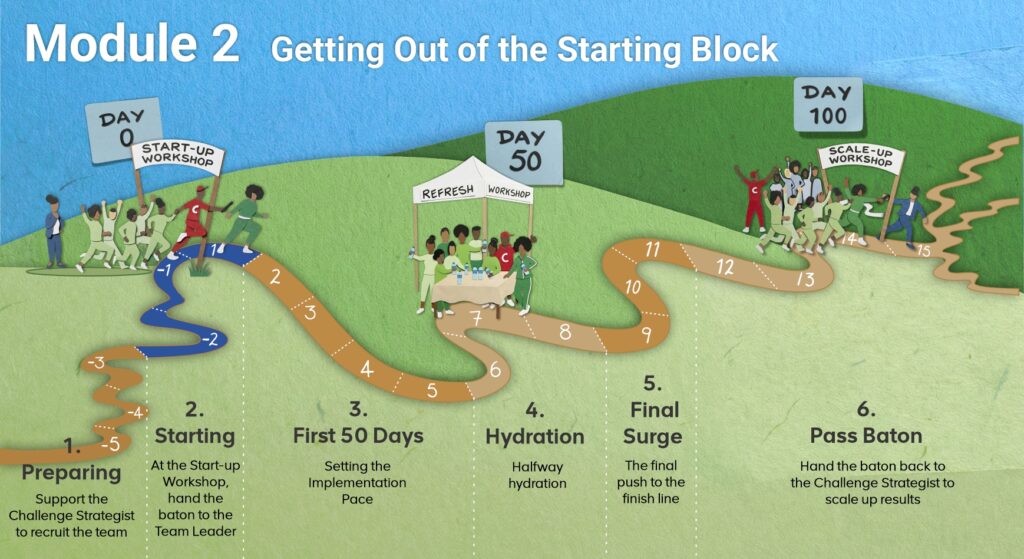




Getting Out of the Starting Blocks - The Start-up Workshop
Before the 100-day clock begins, your work as a facilitator happens behind the scenes. This roadmap guides you through the transition from Logistical Prep to Team Activation.
Podcast
Listen to the conversation between two 100-Day Challenges Coaches, discussing what needs to be done in Module 2 and with great tips!
The Big Picture
The Start-up Workshop is the launchpad for your 100-Day Challenge. It is the critical moment where the frontline team comes together, takes ownership of the challenge, and negotiates their “unreasonable” 100-day goal. To succeed, you must ensure that the team is fully prepared, logistics are flawless, and leadership is aligned. Over the next few weeks, you will transition from behind-the-scenes preparation to active facilitation, setting the stage for the sprint.
Your Roadmap
Week Minus 2: The Pre-sprint Check
In the GBVF context, collaboration often fails due to “siloed” departments. This week, you ensure that representatives from all the organisations and departments aren’t just invited, but prepared.
Key Action: Confirming that designated Team members are able to participate in the 100-Day sprint.
Facilitator Move: Assessing if the “invitation” to the team was compelling enough to trigger real urgency.
Week Minus 1: The Rehearsal
Facilitating a high-stakes workshop requires more than just a slide deck; it requires a mindset. You will finalize the “Architecture of the Room” (whether physical, emotional, or digital).
Key Action: Reviewing the Start-Up Workshop agenda minute-by-minute.
Facilitator Move: Visualizing potential “tension points” during the goal-setting exercise and planning how to navigate them.
Week 1: The Start-up
The 100 days officially begin. This is the most intense week, where theory becomes practice.
Key Action: Facilitating the Start-Up Workshop and the first one-on-one with the Team Leader.
Facilitator Move: Stepping back to let the team struggle with their goal negotiation—this “struggle” is where their collective agency is born.
Your Action Checklist
To stay on schedule, please ensure the following steps are completed by the end of this module:
Alignment: Ensure the “Sponsors” (Leadership) and the “Team” are on the same page. You are confirming that the designated team members will show up to the Start-up Workshop, and the logistical stage is set.
Confidence: Finalise your facilitation plan. This week is about mastering the flow of the Start-Up Workshop so you can lead with authority and calm.
Ownership: Facilitate the workshop where the team sets their SMURF goal. Your focus shifts to coaching the newly minted Team Leader.
What's Next?
Pro-Tip for Facilitators: You aren’t just a “manager” during these weeks; you are an architect. If the foundation you build in Weeks minus 2 and minus1 is solid, the team will be able to withstand the pressure of the 100-day sprint.
After Week 1 come back to the page to complete your module assignment – have a peak at the questions now…
Jot down thoughts on these questions – to the extent they are relevant to your experience at the session:
When did the mood in the event shift from “why are we here?” to “this could be interesting – I am excited to be part of this.” What triggered this shift?
When did you have to go “off script” on the agenda or to change the agenda? What triggered this? What did you adjust? How did it go?
What was most surprising to you at the event?
What new insights did you gain about the issue at hand, and about the way leaders in the system interacted with each other?
Where did the conversation get stuck? What got it unstuck?
How would you characterise the level of trust among participants in the meeting? To what extent did this shift as the meeting progressed? To what do you attribute this shift, if indeed it happened?
Thought starter...
Reflection Questions
Jot down thoughts on these questions – to the extent they are relevant to your experience at the session:
When did the mood in the event shift from “why are we here?” to “this could be interesting – I am excited to be part of this.” What triggered this shift?
When did you have to go “off script” on the agenda or to change the agenda? What triggered this? What did you adjust? How did it go?
What was most surprising to you at the event?
What new insights did you gain about the issue at hand, and about the way leaders in the system interacted with each other?
Where did the conversation get stuck? What got it unstuck?
These are 100-Day Challenge Mentors.
They did some work before you received the Challenge Note. This included:
Writing the Challenge Note, and making sure that the leaders of all the organisations represented on the team are comfortable with it – and committed to supporting the work of the team
Helping the leaders of these organisation recruit you and your colleagues to the team
Gathering some baseline data and other information that will help you and your teammates set your 100-Day goal and develop your plan.
Making sure all the preparations are made for a successful Lift-Off workshop, when you and your teammates will meet and get your 100-Day Challenge started. This includes venue, facilitation support, food, swags, comms, travel arrangements and whatever else is needed.
Mentors will participate in all or part of the Lift-Off Workshop, mostly at the start to provide context and answer questions, and at the end to give you and your teammates feedback about the goal and plan you develop.
During the 100 days following the Lift-Off Workshop, here’s what the Mentors will do:
They will check in every two weeks with the team leaders to see how the team is doing and what support they and the team need.
They will keep other organisational leaders informed and engaged during the 100 days, and pull them in to help as needed.
They will participate in the last part of the Refuelling Workshop, halfway through the 100 days, to see what additional support the team needs, and to begin to plan with the team for sustainability and scale-up.
They will work with the team at the Sustainability Workshop to finalise recommendations on sustaining the results and building on the work of the team.
Login
Accessing this learning programme requires a login. Please enter your credentials below!