









Creating the Enabling Environment for 100-Day Challenges

Creating the Enabling Environment for 100-Day Challenges

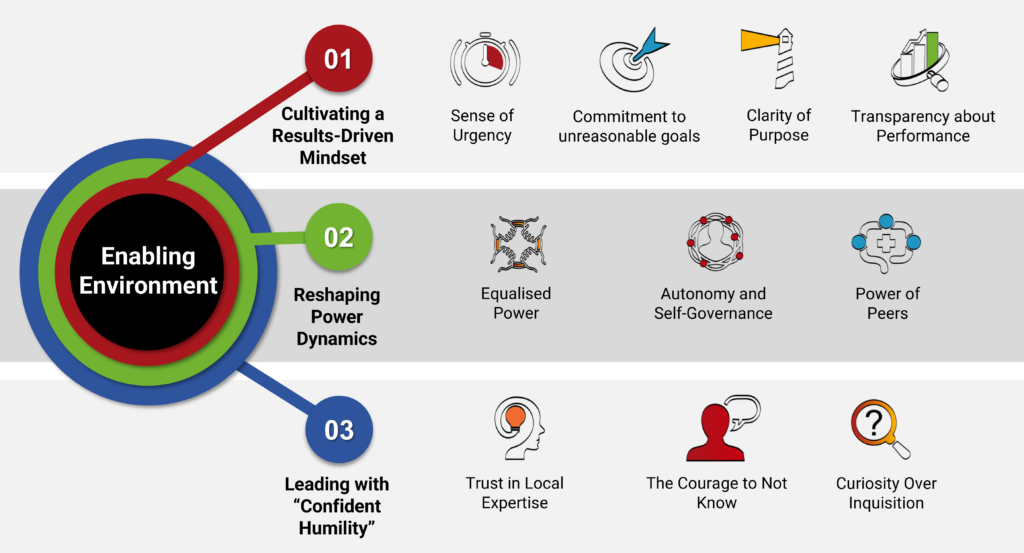
As a Coach, you are the architect of a unique culture. Your role, alongside the Challenge Strategist, is to build and protect an “enabling environment” that fosters three hallmark behaviours: intense collaborationrapid innovation, and disciplined implementation.

This environment is not based on academic theory; it is distilled from decades of real-world experimentation with teams tackling complex social issues. These are “work in progress” as the community of 100-Day Challengers continues to uncover other elements that enable 100-Day Teams to perform at exceptionally high levels. 

Deep Dive Video

Enabling Environment Overview

Reinforcing These Elements During 100-Day Challenge Sprints

Nr 1

Cultivating a Results-Driven Mindset

To move the needle on community-level social impact, the Team must operate with a different frequency than traditional government cycles.

SEnse of urgency

Sense of Urgency

At the Start-up Workshop, ask the team which new experiments they will launch in the first 30 days. Remind them that in a 100-day sprint, time is the most precious resource.

Commitment to goal

Commitment to “Unreasonable” Goals: When a team sets a goal that represents a massive leap over past performance, honour that bravery. Express genuine appreciation for their commitment to a target that might look “unreasonable” to outsiders.

Clarity of purpose

Clarity of Purpose

In every meeting, ask the team to restate their 100-Day Goal. It is easy to get lost in the “busy-work” of the plan and forget the actual impact they are trying to achieve

Transparancy about performance

Transparency about Performance 

Always know exactly where the team stands against the goal. Remind them that being “behind” is simply a signal to pivot: “The sooner we know we are behind, the more time we have to catch up!”

Nr 2

Reshaping Power Dynamics

In collaborative projects involving multiple organisations, traditional hierarchies can stifle innovation. You must actively work to “level the playing field.”

Equalised power

Equalised Power 

When the team looks to you or a leader for a decision, hand the power back to them. Remind them that for these 100 days, they are the ones in charge, and you are there to support their vision.

Not intefering

Autonomy and Self-Governance

If a member approaches you privately for advice, gently redirect them to their teammates and the Team Leader. This reinforces the Team as the primary unit of authority.

Power of peers

Power of Peers

If a problem arises, resist the urge to provide the “right” answer. Ask, “What do others think about this?” first, and build on the collective wisdom of the group.

Nr 3

 Leading with “Confident Humility”

The most powerful 100-Day Challenges happen when leaders trust the experts closest to the problem—the frontline workers and community members.

Trust in local expertise

Trust in Local Expertise 

 Regularly remind the team: “You are closest to the problem; your solutions are more relevant than mine.”

Close Out

The Courage to Not Know

Do not hesitate to say, “I do not know the answer, but I will help you find it.” This models the vulnerability needed for true innovation.

Clarify

Curiosity over Inquisition

Ask open-ended questions with genuine interest. Avoid “Yes/No” questions that feel like a performance audit rather than a supportive coaching session.

Quiz Yourself